

Getting random FPS drops in Blade Symphony can be really annoying, especially when the game runs perfectly one minute and starts stuttering the next. In some cases, the problem is not your graphics card at all. Outdated drivers, shader compilation, high temperatures, background apps, or a few demanding settings can all affect performance.
The good news is that most of these problems are fairly easy to check.
Try the fixes below one at a time. You don't need to change everything at once.
1. Check Your PC First
Before changing game settings, make sure your PC is actually capable of running Blade Symphony comfortably.
Check your:
- CPU
- GPU
- RAM
- Storage
- Windows version
If your hardware is only around the game's minimum requirements, you may need to use lower graphics settings to maintain a stable frame rate.
2. Update Your GPU Driver
This is one of the first things I'd check.
Whether you're using NVIDIA, AMD, or Intel graphics, an old driver can cause poor performance or random stuttering in newer games.
Install the latest driver for your graphics card, restart your PC, and then launch Blade Symphony again.
If the problem started immediately after a driver update, trying the previous stable driver can also be worth testing.
3. Let the Shaders Finish
If Blade Symphony is compiling or preloading shaders, don't rush into the game.
Shader compilation can cause temporary stutters, particularly after installing the game, updating it, or changing graphics drivers.
Let the process finish completely and then restart the game.
For many players, this simple step can make the first few minutes of gameplay noticeably smoother.
4. Try Another Display Mode
Open the display settings in Blade Symphony and switch between:
- Fullscreen
- Borderless fullscreen
- Windowed mode
Start with fullscreen if your setup supports it. If you're still getting strange frame drops, test borderless mode and compare the results.
Sometimes the difference is surprisingly noticeable.
5. Run Blade Symphony as Administrator
This is worth trying if the game is behaving strangely or having problems accessing files.
Find the game's executable, right-click it, choose Properties → Compatibility, and enable Run this program as an administrator.
Apply the setting and start the game again.
6. Don't Turn Every Setting to Ultra
Ultra settings look great, but they aren't always worth the performance hit.
If your FPS is dropping, start by lowering the settings that usually put the most pressure on your hardware:
- Shadows
- Reflections
- Volumetric effects
- Ambient occlusion
- Particle effects
- View distance
You don't have to make the entire game look bad. Lower a few heavy settings first and see how much FPS you gain.
7. Try DLSS, FSR, or XeSS
If your system supports one of these technologies, give it a try.
DLSS, FSR, and XeSS can improve performance by rendering the game at a lower internal resolution and then reconstructing the image.
If you're struggling to maintain your target FPS, this can often be a better option than simply lowering the game's resolution.
8. Test Frame Generation
Some supported hardware and versions of Blade Symphony may offer frame generation.
Turn it on and test the game for a few minutes.
Don't judge it only by the FPS counter, though. Pay attention to how the game actually feels. If the base frame rate is already very low, frame generation may not solve the underlying performance problem.
9. Close Apps You Don't Need
Take a look at what's running in the background before launching Blade Symphony.
A browser with 30 tabs, video-editing software, launchers, cloud-sync tools, and other applications can quietly use a lot of RAM and CPU resources.
Close anything you don't need while gaming and check the FPS again.
10. Pause Downloads
Large downloads can put extra pressure on your internet connection and storage drive.
Pause downloads from Steam, other game launchers, Windows Update, cloud-storage apps, or similar services while playing.
This is especially worth trying if you notice stuttering while new game files or updates are being downloaded.
11. Turn Off Unused Overlays
Game overlays are convenient, but you don't necessarily need all of them running.
Try temporarily disabling overlays from applications such as:
- Discord
- Steam
- NVIDIA App
- AMD Software
- Xbox Game Bar
Restart Blade Symphony after disabling them and check whether the stuttering has improved.
12. Stop Background Recording
Windows and graphics software can record gameplay in the background without you actively thinking about it.
If you don't use recording or instant replay features, turn them off temporarily.
This gives your system a little more breathing room while Blade Symphony is running.
13. Use a Performance Power Mode
Windows can sometimes prioritize power saving instead of maximum performance.
Open Windows Settings → System → Power and select an appropriate performance-oriented power mode.
If you're playing on a laptop, keep the charger connected. Gaming on battery power can significantly reduce performance on many laptops.
14. Make Sure Blade Symphony Is Updated
Don't ignore game updates when troubleshooting FPS problems.
Developers often release patches for performance issues, crashes, graphics bugs, and hardware compatibility.
Open your game launcher and make sure you're running the latest available version of Blade Symphony.
15. Verify the Game Files
A damaged or missing game file can cause more than crashes. It can also result in strange loading problems and inconsistent performance.
Use your game launcher's Verify, Repair, or similar option.
Let the process finish before starting the game again.
16. Update Windows
It is also worth checking Windows Update.
Install pending updates and restart your computer before testing Blade Symphony again.
This is particularly useful if you've recently installed a new graphics driver or other hardware software.
17. Check Your Temperatures
If the game starts smoothly but FPS drops after playing for a while, temperature is one thing you should check.
Monitor your CPU and GPU temperatures while playing.
If either component becomes too hot, it may reduce its clock speed to protect the hardware. That's known as thermal throttling.
Also check whether your PC has:
- Dust blocking the fans
- Poor airflow
- A fan that isn't working properly
- Excessive heat buildup
18. Remove Any Unstable Overclock
An overclock that looks stable in one game isn't necessarily stable everywhere.
If you've overclocked your CPU or GPU and Blade Symphony is experiencing crashes, stutters, or strange FPS drops, return the hardware to its default settings and test again.
If the problem disappears, the overclock may be responsible.
19. Check Your RAM
Open Task Manager while Blade Symphony is running and look at your memory usage.
If your RAM is almost completely full, Windows may start relying more heavily on virtual memory, which can contribute to stuttering.
Close unnecessary applications and test the game again.
20. Don't Disable Windows Virtual Memory
Windows uses a page file as additional virtual memory when necessary.
Unless you have a specific reason to change it, leave Windows virtual memory enabled.
Disabling it can create unnecessary memory problems when a game and other applications use a lot of RAM.
21. Install Blade Symphony on an SSD
If you're still using a traditional hard drive, moving Blade Symphony to an SSD can make a noticeable difference to loading and asset streaming.
An SSD won't magically double your FPS, but it can help with:
- Loading times
- Texture or asset streaming
- Level loading
- General responsiveness
Also make sure the SSD has enough free space.
22. Try a Clean Boot
Still getting unexplained stuttering?
A Windows clean boot can help identify whether another program is interfering with the game.
It starts Windows with a limited selection of services and startup applications. If Blade Symphony suddenly runs better, you can gradually enable those programs again and find the one causing the conflict.
23. Reinstall the Graphics Driver
If updating the GPU driver didn't help, consider performing a clean driver installation.
Remove the existing driver using an appropriate driver-cleanup method and then install the latest driver directly for your graphics card.
Restart Windows before testing Blade Symphony again.
24. Check Your Resolution
Resolution has a big effect on GPU usage.
If you're playing at a very high resolution and your GPU is struggling, try lowering it temporarily.
You can also use an upscaling option such as DLSS, FSR, or XeSS if available.
A small reduction in image quality can sometimes give you a much smoother experience.
25. Try an FPS Limit
Unlimited FPS isn't always the best option.
If your frame rate constantly jumps up and down, try setting a reasonable FPS limit.
For example, if you have a 144Hz monitor, you could test a limit around 140 FPS rather than allowing the game to run completely uncapped.
The goal isn't simply a high FPS number. Consistent frame pacing can make the game feel much smoother.
26. Reinstall Blade Symphony
If you've tried everything above and nothing has helped, reinstalling the game is the final software fix worth considering.
A fresh installation can remove corrupted files or installation problems that normal file verification sometimes doesn't resolve.
Back up important saves or configuration files first if necessary.
27. Contact Official Support
If Blade Symphony still has serious FPS problems after you've gone through the troubleshooting steps, the issue may be game-specific.
When contacting official support, provide as much useful information as possible, including:
- CPU model
- GPU model
- RAM
- Windows version
- GPU driver version
- Game version
- Average FPS
- When the drops happen
- Error messages
- Screenshots or recordings if available
That gives the support team something useful to work with instead of simply reporting that the game is "lagging."
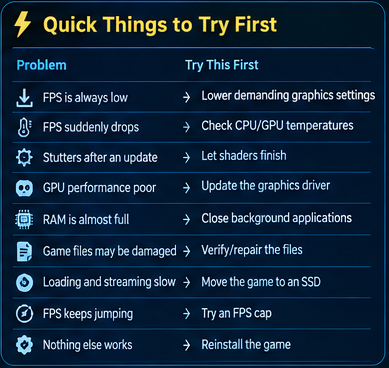
Quick Things to Try First
If you don't want to go through all 27 fixes immediately, start here:
| Problem | Try This First |
|---|---|
| FPS is always low | Lower demanding graphics settings |
| FPS suddenly drops | Check CPU/GPU temperatures |
| Game stutters after an update | Let shaders finish |
| GPU performance seems poor | Update the graphics driver |
| RAM is almost full | Close background applications |
| Game files may be damaged | Verify/repair the files |
| Loading and streaming feel slow | Move the game to an SSD |
| FPS keeps jumping around | Try an FPS cap |
| Nothing else works | Reinstall the game |
Final Thoughts
There isn't always one single reason for low FPS in Blade Symphony. Sometimes it's a graphics setting. Sometimes it's a driver. In other cases, the game may be compiling shaders, the PC may be overheating, or another application may be using resources in the background.
I'd start with the easy fixes first: update the GPU driver, let shaders finish, lower a few demanding settings, close unnecessary applications, and verify the game files.
If that doesn't solve it, move on to temperatures, Windows settings, storage, drivers, and finally a clean reinstall.
For more practical gaming, smartphone, and technology guides, DogPetPuppy.com provides straightforward troubleshooting and how-to articles.
